

Group

No matter how much I enjoy my own company, I will admit that I'm the most me in a group.
It is fairly late realisation1 but also a no surprise one, because I was raised in a joint-family. I have been effectively part of a large group of people for as long as I have been alive, so it seems to be the most natural way for me to be anywhere. Living and being raised with a large group of people means that I am used to strong personalities and being able to navigate differences in opinion and conflicts while balancing love and affection – what nowadays is called soft skills and announced over LinkedIn. I was trained young! But to me, what is interesting is that being part of a family group (even if it is just your parents, their friends and the kids) is that it gives you an inherent support system. From my (limited) experience, disagreement doesn't threaten the fundamental bond.
Over the course of many years, I've somehow ended up collecting people into various groups. I'm not sure if it is because of my upbringing, but it is just how it has turned out. My girl friends, my college friends, my running friends (back from when I was able to run), my work friends, my art class friends, my gym buddies. As you can see, a continuous pattern. I generally love big group hangouts. My policy is often, the more the merrier. Some of these groups of people I've known for over 20 years. Which is wild? I think there's something about growing old with the same group of people that we don't talk enough about. Some of my group of friends have seen so many different versions of me and are still very much around. I'm amazed at the resilience of groups in general. And maybe it's just me, but I have noticed that it is much easier to fall out of sync with individual friends and somehow much easier to stay in touch within a group?
From an evolutionary perspective, species at large have survived in groups. Be it a parade of elephants, a colony of penguins, a school of fish, or a swarm of bees. We've all survived on earth because we're part of a group, something bigger than us individually. But in the human species, it also means that groups have to have a certain sense of synergy while also allowing space for individuals to thrive. We operate in groups to run governments or companies (among many other things!), but we're also individuals who have different interests and opinions based on our experiences. This inherent tension is what makes groups so interesting to me. I love the continuous friction between individual differences and group synergy. I don't think that tension is a bug in the system; I would like to believe it's a feature that made us successful as a species on the planet.

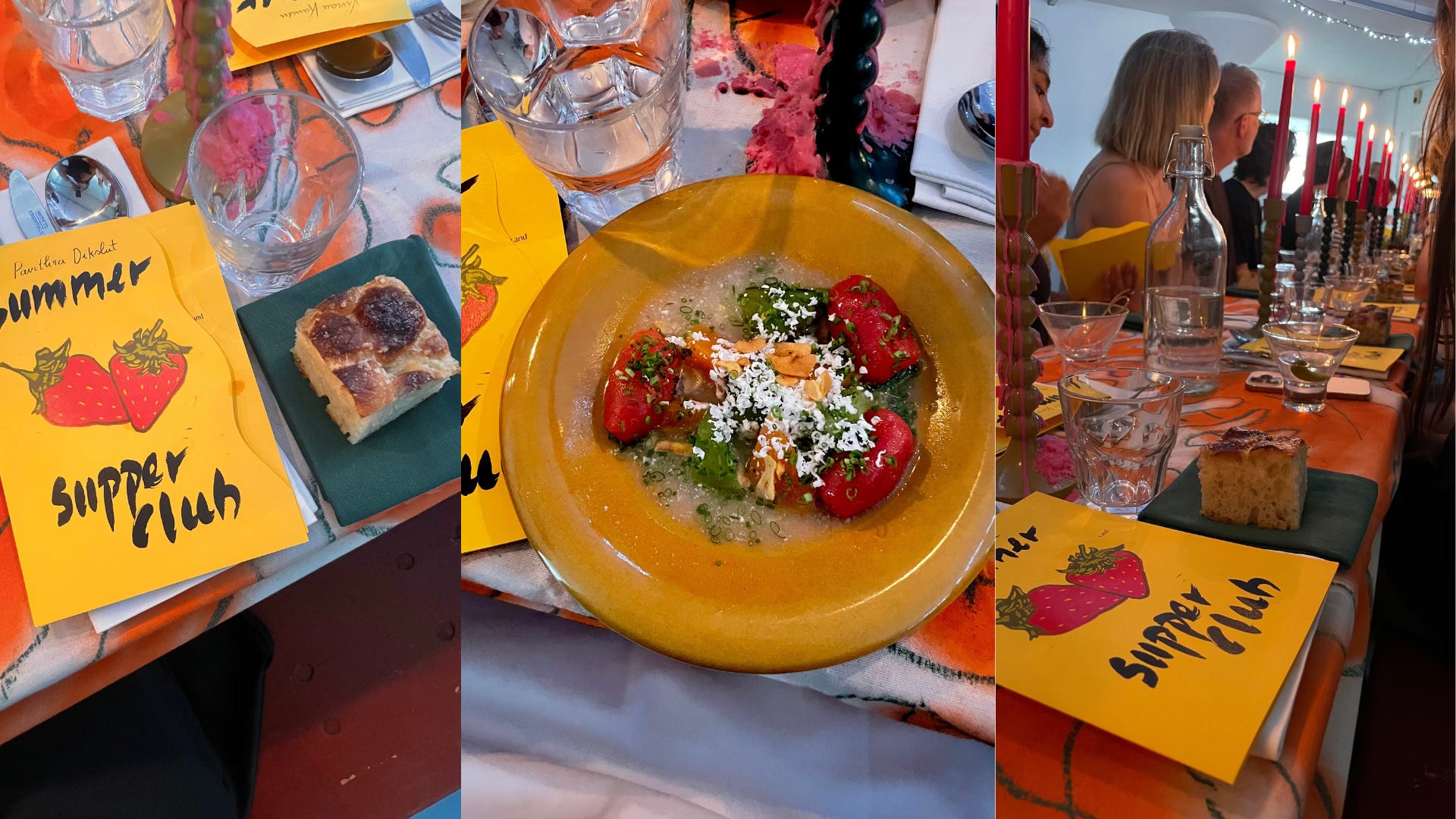
Like many of you, I have a lot of varied interests and I find myself in groups of people who like to do similar things. Groups prepare us to open our thoughts and engage in new experiences. The fun of trying new things for the first time with a new group. They challenge our norms of what is acceptable and what is not. And the internet has definitely made it easier to find community/group (if you're into that) in this era. I recently went to a supper club hosted by Rosie Kellet, who in my opinion is the Queen of communal dinners and communal living! She hosts these quarterly supper clubs with her friends and brings together a wide range of people from the arts to lawyers to bankers to publishers for a night. All the people on the table had a shared love for Rosie and we had lots of varied discussions. I've not laughed so much in a long time, and for a night we were a tight-knit group.
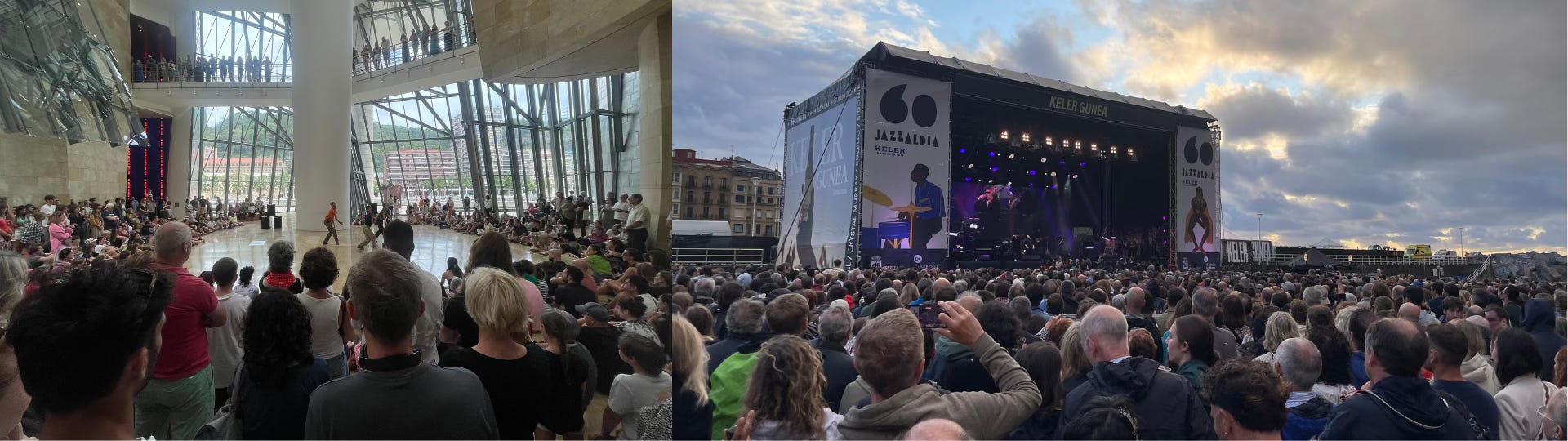
All of these different experiences with a group are starting to resemble a new third space. I recollect a podcast episode with Trevor Noah and Esther Perel where they talk about the friction between people going to a laundromat. These were spaces where you naturally bumped into complexity and had to navigate differences. With better infrastructure and more influx into cities, there has been a disappearance of third places; be it community centers, cafes or public squares/plazas where people come together. But I was pleasantly surprised in both Barcelona and Bilbao that there was a culture where groups of people hung out together in streets and plazas and you could encounter people outside your chosen bubble. While we may or may not follow this anymore, traditional institutions like unions, churches, and civic groups provided structured ways to practice group disagreement. These were places where people had to learn to work together despite their differences because there were larger shared goals (workers' rights, community welfare, spiritual growth). You continually developed 'group muscles'.
While I do enjoy a group hang, I also acknowledge that it is impossible to create intimate connections or even lasting connections within groups unless they become your daily people. I think about groups as a gathering of people. Sometimes it has a shared purpose, like sharing a meal; sometimes it is doing an activity, like running or pottery; and sometimes it is an intellectual and social discourse very similar to Salons hosted in the 17th and 18th century. Salons served as spaces for discussing literature, art, philosophy, and social issues. Discourse was highly encouraged. Having different opinions was sought after and a lot of the time, it was not about being right.
While I do share a love-hate relationship with social media, the original idea of being on social media was to encourage independent thought. It really embraced the quirks of individuals (remember the early days of Twitter?). But contrastingly, in the influencer era, having discourse feels like an attack and nuance in general is entirely lost. People have become less accepting of different opinions and differences are considered unhealthy. The right and the left have become violently opposite. It has become very easy to 'other' someone based on the group you are in. Nameless, faceless people are constantly trolling. Having different opinions suddenly makes you vulnerable to being called out. And the way algorithms are set, you find content similar to ones you like and it becomes a continuous reinforcement of your ideals and ideas. This virtual group mindset of hanging out with like-minded people can pretty quickly devolve into 'groupthink' – where everybody in the group operates in the same way without ever formalizing any rules. Groupthink erodes individualism and instead becomes identity. Either you are a 5am club or a party animal. Either you are a hustler or a girl boss or a trad wife or demure etc. based on the group you end up following the most. People aren't developing their own thoughts as they are in a consumption cycle. They are unable to sit in the discomfort of facing complex characters different from their own. The moment you have a different mindset, you become an outsider. The attention economy literally monetises2 groupthink - influencers profit when followers adopt identical behaviors and purchases. But doesn't every individual have many facets? But to be truly considered an insider, you have to discard your personality and adopt groupthink – where one is allowed to only bring the ones that work in the group. So is that still a group or has it become a cult?
With all of this, are we losing the ability to be more tolerant; the gift of what groups give us?
Groups require a certain degree of trust, I will admit that. But with everything going on in the world, that trust cycle seems to be broken. The fundamental question becomes: Who do you trust and why? Most people probably couldn't vouch for that clearly. As Esther Perel often says, 'We have hundreds of virtual "friends" but no one we can ask to feed the cat.' I feel privileged on that front as even if I am misunderstood or we have disagreements, I would still be home in many of my groups. I never have to worry because they are my people. I am often asked, as I've been single for periods of time in my life, if I ever feel lonely. The answer is usually no because I am often surrounded by groups wherever I go and I feel part of something bigger.
I believe that groups give us tolerance but they also help us provide space, build trust and open our minds. Groups help you grow and make space for the new version of you. To me, they're about shared commitment to weathering each other's changes and challenges. It is not about making friends; it is about evolution. To grow individually, we have to grow collectively. We are only as strong as the weakest link. It is time to embrace the discomfort of the group.
-
1 My coach, P, is going to laugh because many moons ago, I told him very confidently that I was not a people person. I’m going to attribute that conversation to being young and dumb. And of course, we all live and learn.
2 To also add, consumer capitalism requires conformity (everyone buying the same trends) rather than the diversity that makes groups evolutionarily successful.
I grew up in a joint family too, and it has taught me how to accommodate different needs without abandoning my own. A true balancing act! I used to think I didn't like big groups until I recently found a group of diverse yet open-minded people. I truly enjoyed myself and, like you said, felt the most me.
This also reminded me of a recent article I read about how capitalism benefits from people leading atomic lives instead of living in cooperative groups. It means nobody shares anything, and thus, every individual is a better money-making cow.
Enjoyed reading this!
Glad to read you went with group!