

Appetite is Social
14 things I am thinking about in May

The title of this edition comes from a phrase in Ruby Tandoh’s book, All Consuming, which I devoured end to end. While the book is about food, it is also about desire, and the way capitalism shapes what we think we want.
When I read the idea that ‘Appetite is Social’, I realised it is true about everything in our lives. Our appetite for travel, books, film, fashion, electronics, all of it now flows through the same pipe. We travel looking at where everyone is going, we eat and drink from lists or from a stranger with 2 million followers, Pinterest tells us what to find beautiful, we wear clothes that other people have vetted and a random algorithm sends us what we should watch and what we should read.
The dominant logic of the internet does not reward distinctive thinking. It rewards recognisability, relatability, shareability.
Original ideas don’t disappear. They need to be repeated over and over again till they become dominant.
What spreads is appetite.
And appetite, it turns out, is social.
Everything is theatre: In the attention economy, everyone is trying to find a way to grab attention. As Drake’s new album, Iceman, releases today, he and his team found a way to grab his fans a couple of weeks ago in central Toronto. They set up a 25 foot ice sculpture with the date hidden inside it. Fans were using pickaxes, hammers and setting small fires to get to the date but also documenting themselves while doing it. The music almost doesn’t matter anymore; the brief is always “how do we get people talking.” Every release is now a theatre production first.
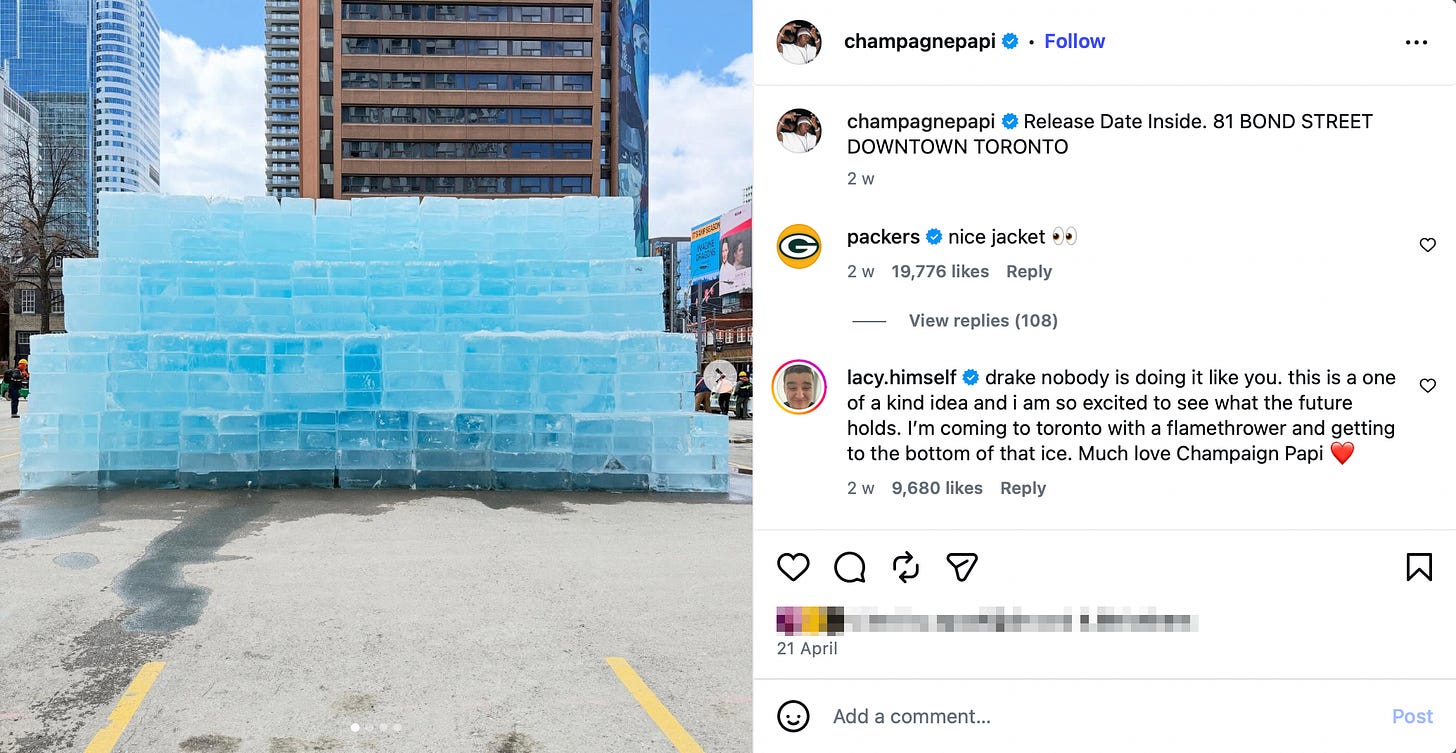
© champagnepapi

Everything gets templatised: Content creators used to be a punchline. Now it’s a business model with a predictable second act: build an audience, launch a brand, print money. Alix Earle, Emma Chamberlain, Mr. Beast are all different categories with the same playbook. This is the ongoing template. I am not immune to buying into this playbook because I do want to try Alix Earle’s Real Actives (the logo does need some work tho!), but I do wonder if we’re at peak. I mean the world is burning… and realistically, how many people are going to buy their own private jet?
Shopping for an identity. Status is always about having what someone else cannot get access to1. People are getting sick of ‘sameness’ in everything, especially fashion (look at the Met Gala drama!). AI is flattening everything into sameness. Distinctiveness is the only available rebellion. So while I see that athleisure is having its moment, I do think we’re close to the turn. People who want to feel like individuals (which is everyone?) will start dressing like they have a point of view again. The era of looking like you might go to the gym is ending. I guess it is time to start building a wardrobe.
Fashion knows no comfort. Chanel has launched a barefoot sandal as part of their latest cruise show. Polarising reviews, predictably. But the thing that sits badly isn’t the sandal. It’s the logic. Going barefoot is not a design choice for a significant portion of the world. It is just life. Fashion has a long history of lifting from the everyday realities of people with less and repackaging it as aspiration for people with more. The barefoot sandal is just the latest, most literal example.
Summer. Is for mangoes. It is also an inevitable heat wave in India. While we have been optimising our lives, unfortunately we have not included weather in it. India records 24 of the 25 hottest cities in the world. As we continue to be the fastest growing economy in the world, India also becomes more and more unliveable. We can blame it on El Nino but let’s just say we bought it upon ourselves.
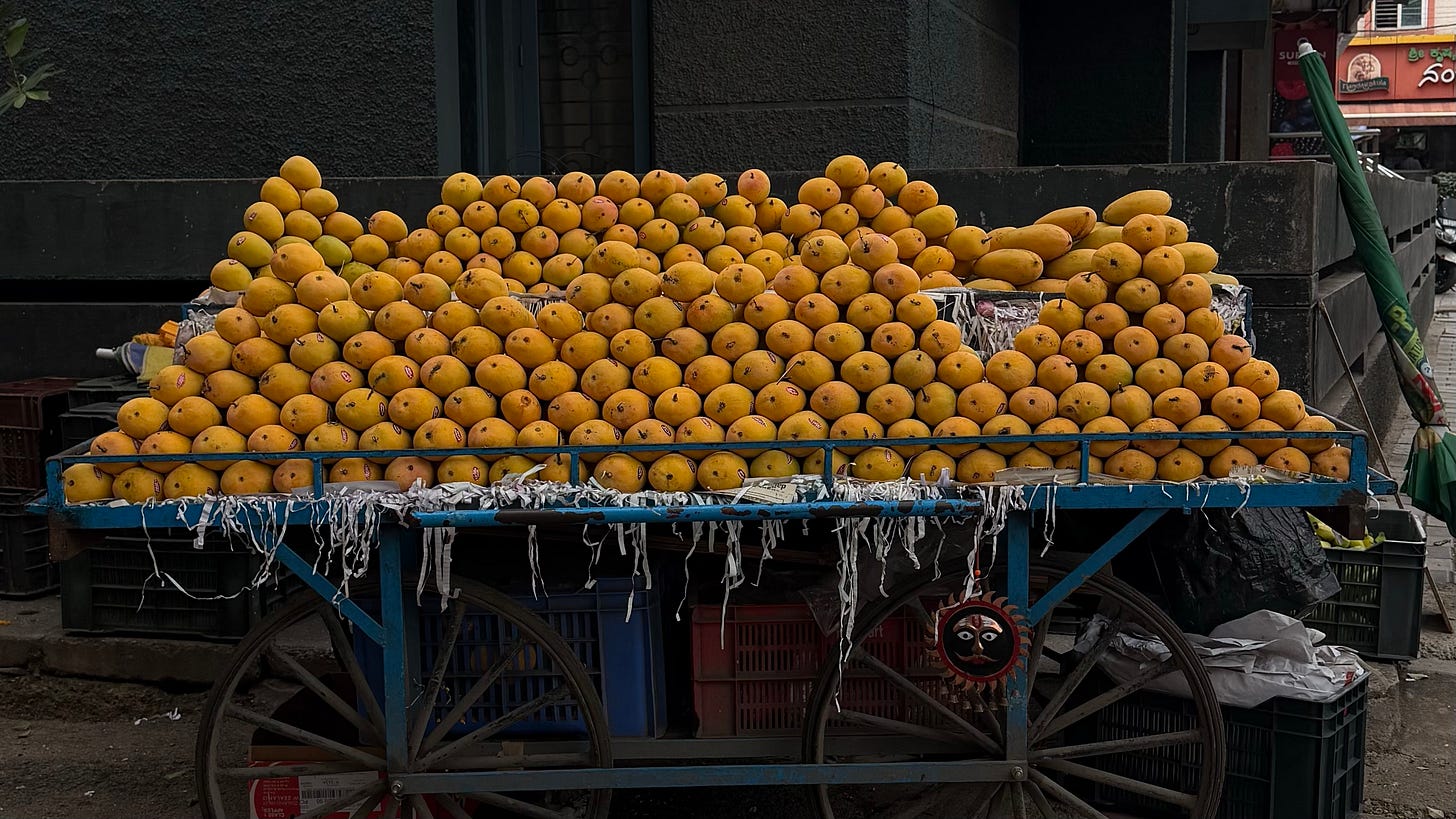
Mango cart in Bangalore, India. Once upon a time. I get sent reels of hidden spots in cities I must visit. Except nothing really stays hidden anymore. I mean, is it really hidden if the reel has a million views? We used to have a category of traveller who proudly went off the beaten path. I wonder what that even means now. The feed finds everything eventually. Discovery might be the thing the internet killed most quietly.
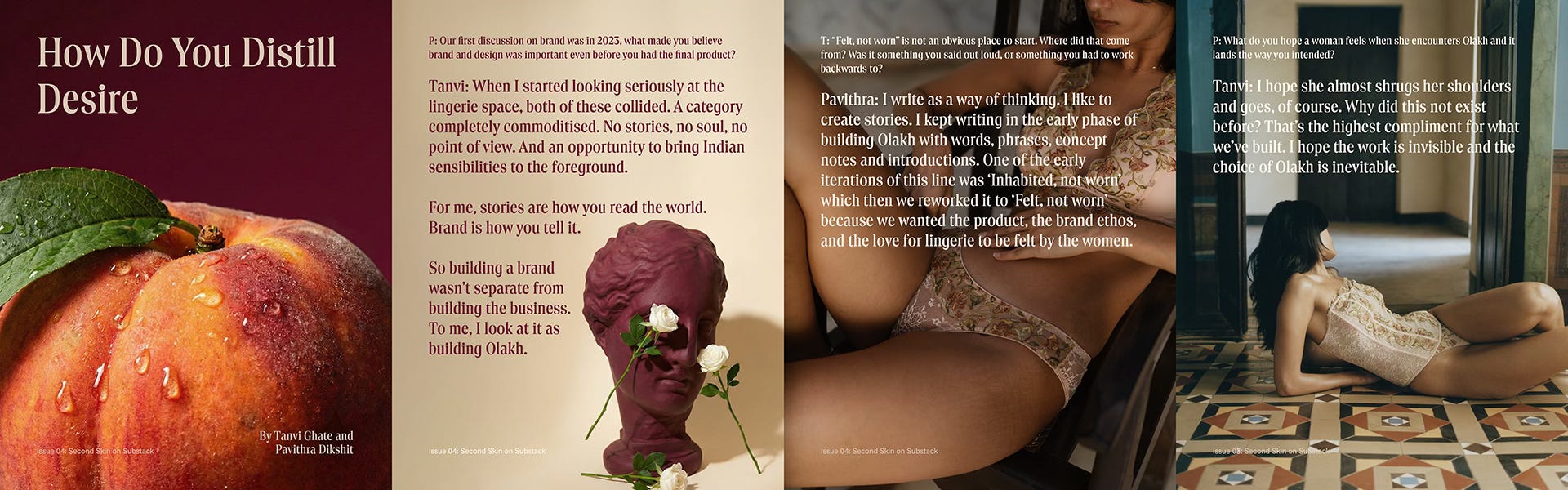
Is Desire Personal? Most of us are still shopping from the feed. Even for the things closest to our skin. Lingerie has been designed, viewed and consumed from a man’s gaze for centuries. So when Tanvi Ghate (Founder) started Olakh, an artisanal luxury lingerie brand from India, I had the opportunity to build the brand. We had many conversations, and we wanted to make sure that intimacy was on a woman’s own terms. Which led us to the philosophy — felt, not worn. In the brand’s latest piece, How do you distill desire?2, Tanvi and I discuss how she started the brand and how it came to be from our first conversation in 2023. Also, you must read her (excellent) interview with The Nod to know the full story!
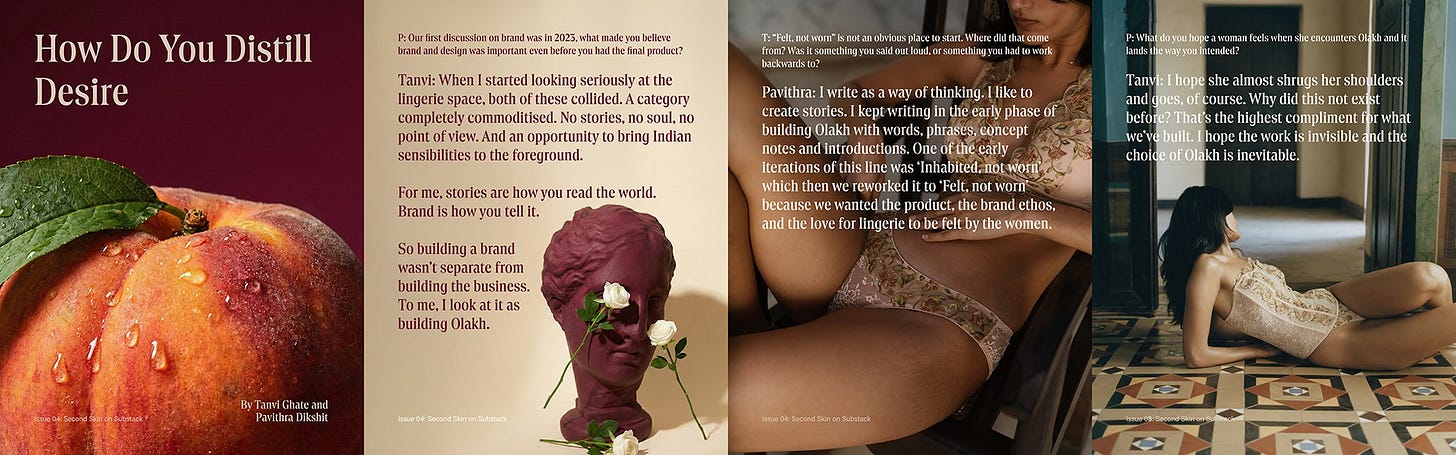
Images ©Olakh Is the grass greener? Gen Z wants to go back to a time before social media. I understand. But nostalgia is a time capsule. Today, you get to enjoy the past in pieces, without living inside it. The pre-social world was also more expensive, more closed, less forgiving of anyone who didn’t take the standard path. The abundance that they’re exhausted by is the same thing that gave them options their parents never had. The freedom and the feed arrived together. At the moment, you can’t have one without the other.
The night is for everyone. I do not know about you but I had a curfew which I willfully hated. The night is young is what I always felt. But TIL that curfew is actually a patriarchal concept. Unsurprised. But what strikes me is that my gut knew before my brain did. Sometimes resistance arrives before the language for it. You push back instinctively against something that doesn’t sit right, and only later find out there was always a very good reason not to sit with it.
Timothee is Marty, Marty is Timothee. Adidas released a long-form ad in the run up to the World Cup, and the Chalamet association will work for them culturally. But watching it, something felt off. The cinematography, the colour grade, the Americana hustle energy. It felt like Marty Supreme was transplanted wholesale into football. In the ad, Chalamet plays the visionary instigator, channeling energy to direct Adidas’ star players against a local team that Zidane and Beckham apparently couldn’t beat. It’s sharp storytelling. But. Marty Mauser was a ping pong player. I am unable to tell if this is a calculated cultural crossover or just the aesthetic gravity of Chalamet being borrowed by everything right now.
Who doesn’t love an upgrade? Since the Industrial Revolution we’ve been in a cycle of optimisation. Time got upgraded to weekday versus weekend. Food got upgraded into protein and fibre ratios because the body became a system to maintain. Then came biohacking: cold plunges, wearable heart rate monitors, supplements for everything. Now AI optimises our travel routes, our music, our dating lives. Is there a finish line in this marathon? Asking for a friend.
The new culture war. One half of the world is an AI optimist, accelerationist, whatever the term is this week. The other half of the world wants to tell you they didn’t use AI (espcl. the creatives) because it’s the equivalent of a slur right now. Every reaction has an equal and opposite reaction. Can’t wait to see who wins and where this beef leads us all. Grab the popcorn, errryone.
Everything is history. At the rate AI companies are building, everything as we know it will soon be unrecognisable. And yet humans have been here before. We fought to stay relevant through the Industrial Revolution, through electricity, through the computer, through every wave of technological change. We adapted. We reinvented. Change is genuinely how we got better than our ancestors. The frustrating part is how selective our learning is3. We absorb technological disruption remarkably well. But, world wars, genocide, political collapse; somehow those lessons never quite stick. We are simultaneously the most adaptable and the most forgetful species on the planet.
How do we even create our own (independent) appetite? So much of our lives are spent on the internet. Everything is social from status to what we eat and cook, where we go to our new interests to class wars to news to friendships. If one truly went offline4 and lived under a rock, where would our appetite to live come from?
Which of these 14 ideas are you sitting with today?

Second Skin is a weekly newsletter published by Olakh, an artisanal luxury lingerie wear brand from India.
In my essay on Skill that I wrote last October, I write about being in an interesting point of inflection in society. And how while we’re all frantically learning and pulling ourselves up to speed, gatekeeping allows the people in power to decide which skills are important. You can read it below.

In Jan this year, I wrote extensively on the privileges of going offline and the performative-ness of it by influencers. Especially because I believe the movement is a modern-day paradox. We are caught in a world that runs online, making it functionally impossible to be offline.
